Need mold remediation services in Eagle?
Found something odd on a wall or ceiling? Send a quick request and a local provider can follow up to talk through your options.
No obligationMold help across the Eagle area from local providers
Request an estimate to get started
Say you pull a box off a basement shelf and find a fuzzy gray patch on the wall behind it. That moment feels big, but you have time to make a calm plan. Mold remediation is the full process of removing mold from your home and fixing what let it grow.
Movementsrepresents Mold Help is a referral service. We do not do the work ourselves. Instead, we connect homeowners in Eagle and the Eagle area with independent providers in our network who handle residential mold removal. On this page you will find what the work includes, what it may cost, how seasons change the timing, and how to pick a provider you feel good about.
Say you open a closet and smell something damp and earthy. Then you see dark spots along the baseboard. Your heart speeds up. That is normal. Mold is common in homes, and there is a clear path forward.
The calm first hour matters more than a fast reaction. Slow down first. A few small choices now can keep the problem from spreading.
Do not scrub, sand or spray bleach on the patch. Rubbing can toss spores into the air and push them into other rooms. Bleach also leaves moisture behind on porous surfaces.
Picture a damp corner of drywall in a closed-up room. Mold feeds on wet wood, paper backing, dust and fabric. Once it settles in, it keeps growing as long as the spot stays damp.
What you see on the surface is often just a small part. Mold can run behind paneling, under flooring and inside wall cavities. Waiting can turn a small cleanup into a bigger job, so a prompt look helps.
Think of it as a short list of jobs done in order. A provider usually starts by finding how far the mold has spread. Then comes the work itself:
Every home is different, so the written plan should match yours.
Say a crew opens a moldy wall with no barrier. Dust and spores can float into the hallway, the kitchen and the vents. That is how a one-room problem becomes a whole-house one.
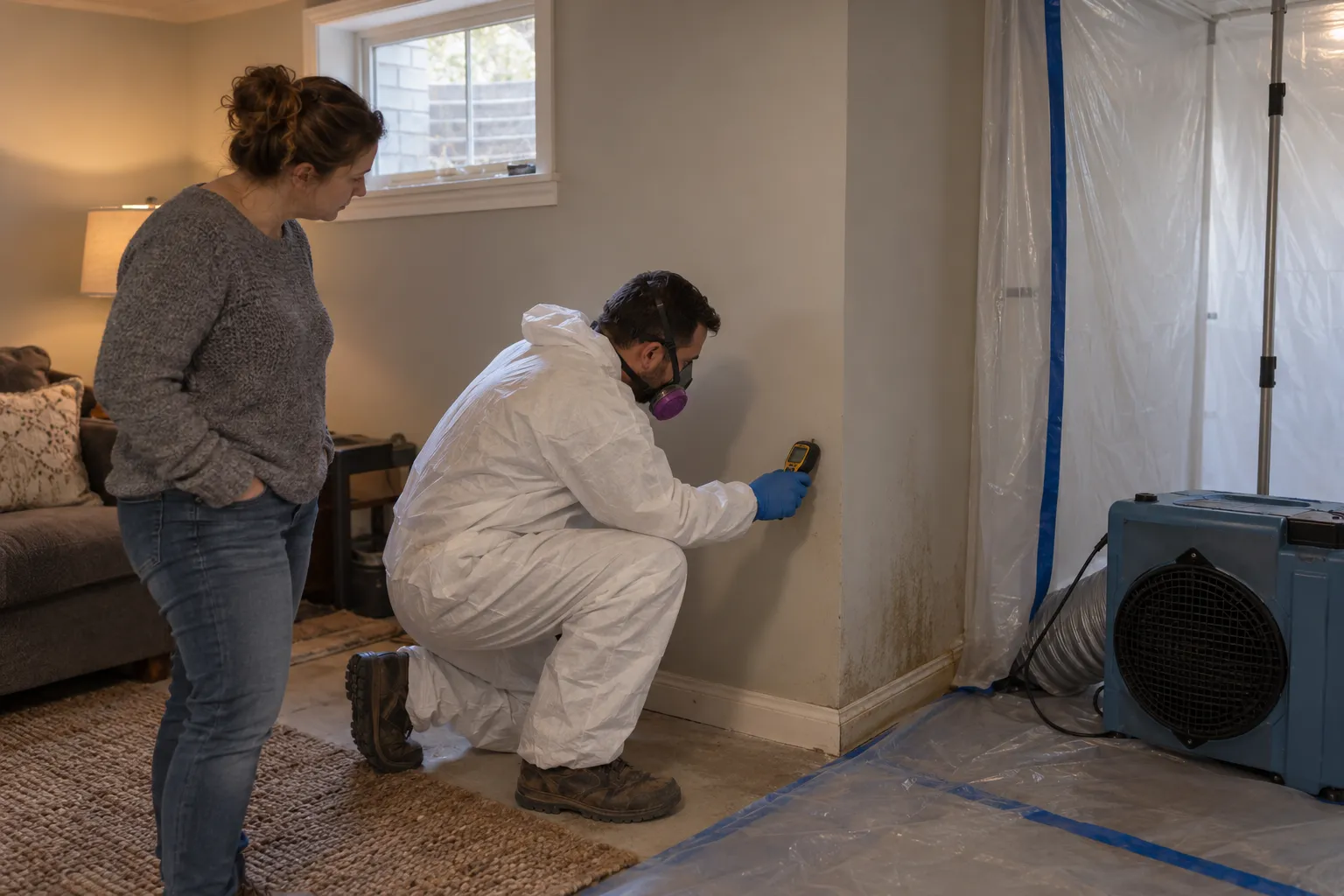
Good providers hang plastic sheeting, seal vents and use air filtration with fans that pull air out of the work zone. Ask how the provider plans to contain your space. A clear answer is a good sign.
Removing mold without fixing the water is like mopping while the faucet runs. Find the moisture, or the mold will return.
In homes like yours, common sources include:
A provider can check for these sources and tell you what needs repair first.
Spring thaw and heavy rain push water toward foundations. Humid summers keep basements clammy for weeks. Fall is a smart time to dry things out and check gutters before freezing weather. In deep winter, a sealed-up house traps moist air from showers and cooking.
Because of this, providers can get busy after big storms and flood seasons. Request a callback to check provider availability, or send a request and share your preferred timing.
Say the mold started after a burst pipe or a storm. Some policies may cover sudden damage, but many do not cover slow leaks or long-term dampness. Read your policy and ask your agent before work begins.
Providers can often help document damage for a claim with photos, notes and written scope. Keep every receipt and report in one folder.
A few plain questions go a long way:
Be careful if one company both tests and removes. Some homeowners prefer a separate tester for a fair second opinion.
Say the work is done and the room feels fresh. Now keep it that way. Aim for indoor humidity below about 50 percent, run a dehumidifier in the basement, and test your sump pump before storm season.
Clean gutters, point downspouts away from the house, and fix drips early. Check the repaired area every few weeks for the first season. If anything looks off, tell the provider quickly.
Plastic barriers and filtered air keep spores in the work zone and out of the rest of your home.
Soaked drywall, insulation and carpet that cannot be cleaned are cut out and bagged for disposal.
Framing and hard surfaces are cleaned, then dried fully before anything is rebuilt.
The provider looks for the leak or humidity that fed the mold, so it does not return.
Prices vary a lot by home, size and how deep the mold goes. These are typical U.S. ranges, not quotes. Always get a written quote that lists the scope before you agree to any work.
| Item | Typical range | Notes |
|---|---|---|
| Small area cleanup | $500 – $1,500 | One wall or a patch under a sink |
| Single room | $1,500 – $4,000 | Includes containment and cleaning |
| Finished basement | $3,000 – $10,000 | Depends on wet drywall and flooring |
| Whole-house project | $10,000 – $30,000 | Large spread, often several rooms |
| Air or surface testing | $300 – $1,000 | Often priced per sample or visit |
| Moisture repair | $500 – $5,000 | Sump pump, gutter or leak fixes vary |
Close the room, stop fans and leave the mold alone. Take photos and write down what you smell.
Send a short request, and a local provider in our network reaches out to you.
The provider checks the spread, finds the moisture and puts the scope and price in writing.
Work is contained, mold is removed, the area is dried and then checked.
Independent providers in our network work in homes like yours, from older frame houses to ranch homes.
Short, clear steps help you stay calm and know what to ask before you hire anyone.
Request an estimate to compare scope and price, with no obligation to move forward.
Movementsrepresents Mold Help refers you to providers. The providers do the work, not us.
Found something odd on a wall or ceiling? Send a quick request and a local provider can follow up to talk through your options.
No obligationFound something odd on a wall or ceiling? Send a quick request and a local provider can follow up to talk through your options.
No obligation